Advantages of AFEX Dual Agent Fire Suppression Systems
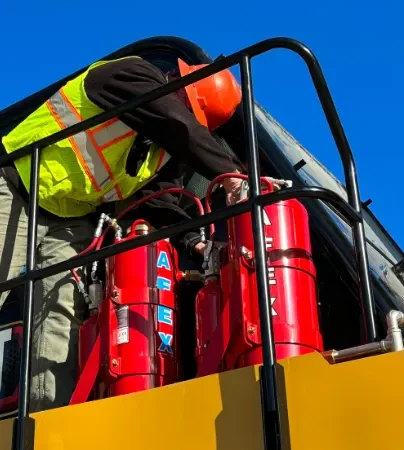
AFEX dual agent fire suppression systems are commonly used on heavy-duty mobile equipment where fire risk is higher and conditions are more demanding. The key idea behind the system is simple: it uses two different suppression agents together to handle different parts of a fire more effectively than a single-agent system.
Those two agents are dry chemical and liquid chemical, and each plays a different role during suppression.
Fast flame knockdown and surface cooling
What makes dual agent systems effective is how quickly they can deal with both flames and heat at the same time.
The dry chemical agent is responsible for the initial knockdown. It floods the protected area and interrupts the chemical reaction of the fire, which stops the flames very quickly.
At the same time, the liquid agent focuses on cooling hot surfaces like engine blocks, exhaust components, and turbochargers. That cooling effect is important because it helps prevent the fire from reigniting once the flames are out.
Together, it’s a two-step approach: knock the fire down fast, then control the heat.
Broader protection across different fire risks
Because two different suppression methods are working together, dual agent systems cover a wider range of fire scenarios.
They’re effective in enclosed compartments like engine bays, where total flooding is needed, but also handle situations involving spilled fuel or debris.
They’re also suitable for multiple fire classes, including solid materials, flammable liquids, and electrical-related fires.
Another important factor is performance in extreme environments. These systems are designed to operate in very cold conditions, down to around −40°, which is critical for mining, forestry, and other outdoor applications.
Compact and efficient design
Compared to liquid-only systems that may require larger tanks or additional capacity to achieve similar performance, dual agent systems tend to be more compact.
That smaller footprint matters on mobile equipment where space is limited and every pound counts. In many cases, it also helps preserve payload capacity.
There’s also a practical cost advantage in some applications, since you’re not relying on a single large-volume agent system to handle all fire scenarios.
Meets recognized safety standards
Dual agent systems are widely accepted in heavy equipment fire protection standards and are often required depending on the application.
For example, NFPA guidelines require dual agent suppression on certain large hydraulic machines due to the amount of hydraulic fluid present and the associated fire risk.
In practice, this means these systems are not just an optional upgrade in many industries—they’re part of compliance and site safety requirements.
Flexible detection and activation
These systems can be set up to activate automatically when a fire is detected, but they also include manual activation options if needed.
They can be integrated with control units that monitor for fire conditions and trigger discharge, and in some setups, they can also connect to alarm or telematics systems for remote notification.
This flexibility helps ensure the system responds quickly whether or not an operator is present.
Purpose-built, balanced protection
The main advantage of a dual agent system is that it doesn’t rely on a single method of suppression.
Dry chemical handles rapid flame suppression, while the liquid agent deals with heat and re-ignition risk. Together, they provide a more complete and balanced response to real-world fire conditions on heavy equipment.
Summary
In practical terms, AFEX dual agent systems offer:
- Fast flame knockdown combined with effective cooling
- Broader protection across multiple fire types
- Compact, space-efficient design for mobile equipment
- Compliance with NFPA and industry safety standards
- Flexible automatic and manual activation options
- A more complete approach to complex fire risks
These systems are designed for environments where downtime, safety, and equipment protection all matter at the same time, especially in high-risk mobile and industrial applications.